 Dutch
Dutch English
Lineback Gonda: Where different colours meets high genetics
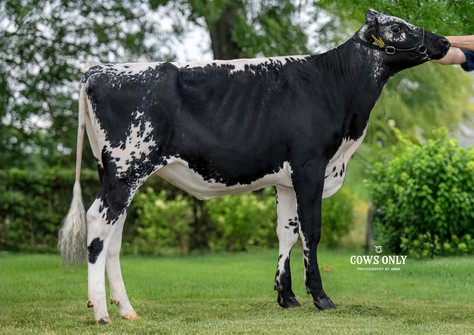
Bacchus HiPo S Gonda WR (Sem x Comeback)
A promising new generation from the WEH Georgina family has emerged with Bacchus HiPo S Gonda WR. The young heifer calf is a daughter of Harpet Sem out of WSH Goldmarie, who was purchased by Bacchus Holsteins and HiPo Genetics at the Masterrind Exclusive Sale in 2024. Since her purchase, Goldmarie has already produced several interesting offspring from different matings.
Gonda combines a strong genetic profile with a striking Lineback pattern. She is currently the No. 1 female Lineback for gNVI (April 2026) and scores 338 gNVI with a flawless genomic profile. The young Sem daughter demonstrates that distinctive colour inheritance can go hand in hand with strong genetic potential.
Her dam WSH Goldmarie GP-82 also has an impressive record. In 305 days, she produced 11,227 kg of milk with 4.42% fat and 3.72% protein, while also combining production with high health breeding values. Her dam, WSH Great GP-83 (s. Comeback), was successfully used as a bull dam.
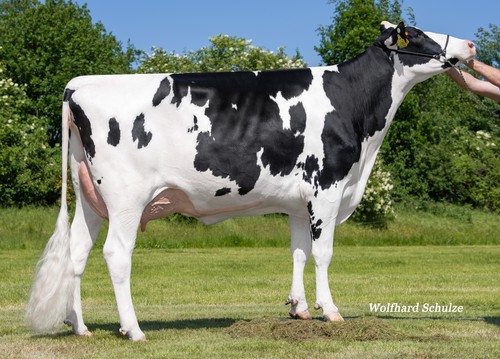
Granddam: WSH Great GP-83
Goldmarie is now making her mark through several different branches of her offspring. Bacchus HiPo Hi Gisela (s. HiNote), for example, scores 3375 gTPI in America and is currently No. 1 among HiNote daughters for gLPI, gPFT and gICO (August 2026). Another impressive daughter is Bacchus HiPo RUW Goldy (s. Surfer), testing at 152 gRZG and 3155 gTPI after being born from an embryo sold to AI station RUW. The maternal line traces back to SHA Rubicon Grumeti VG-87, an influential brood cow behind several successful offspring and sires. Among them is SHA Foreman, who ranked No. 1 for RZG in April 2021.
For Bacchus Holsteins, Gonda's birth is particularly special. Jan van de Braak is an active Dutch Lineback breeder and enthusiast, making the combination of an interesting Holstein cow family with distinctive colour inheritance a natural fit within the Bacchus breeding program.
Her sire Harpet Sem is a Holstein bull carrying Witrik colour inheritance. When used on normally coloured animals, approximately half of the offspring can display the characteristic Witrik pattern. This adds a distinctive visual feature to a pedigree that already offers plenty of genetic potential.